

Top performer in EU integration
Croatia’s entry into the Eurozone and the Schengen area was an undeniable success for the EU’s youngest member state. The adoption of the European currency was a priority for the current Prime Minister Andrej Plenković and the governor of Croatia’s central bank, Boris Vujčić, who lauded its benefits to the public. This milestone event took place on 1 January 2023.
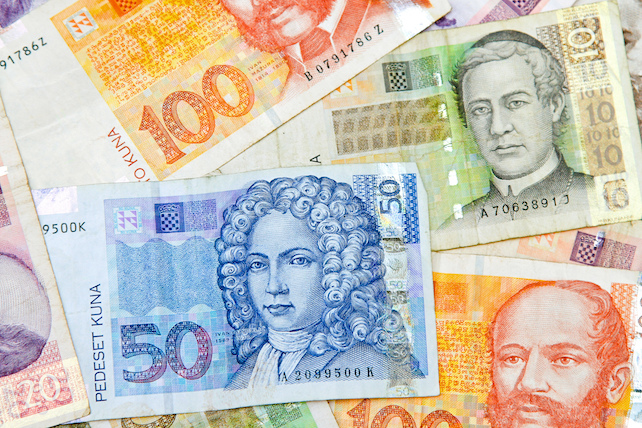
The transition from the kuna to the euro was relatively smooth as Croats had already been using the single currency (and previously the German mark) in their day-to-day lives, and had kept their savings and taken out loans in it even before their country officially joined the monetary union. About two-thirds of the country’s public debt was denominated in euros.[15] In 2021, EU countries, mainly from the Eurozone, such as Germany, Italy and Slovenia, accounted for more than 70% of Croatia’s trade. By adopting the single currency, the country has gained greater price stability and reduced the exchange rate risk in trade transactions. Another positive consequence of this step is the rising value of foreign investments, which have been flowing in mainly from EU member states: Austria, the Netherlands, Germany, Italy and Luxembourg. The most important branch of the economy has also benefited, as more than half of all tourists come from Eurozone countries. The government in Zagreb hopes that Croatia’s accession to the Eurozone will raise its political standing in the community, thus bringing it into the mainstream of integration.
To Sarajevo via Berlin
After the overarching foreign policy goals from the beginning of this century were achieved with the accession to NATO (2009) and the EU (2013), over the last decade Bosnia and Herzegovina has become one of the most important fields of activity for Croatian diplomacy, which has focused on defending the interests of the Croats who live there. All the governments in Zagreb to date have emphasised the importance of this issue. The Croats, who live mainly in the southwestern part of Bosnia and Herzegovina, do not have their own entity within this federal state.[16] Croatian governments have claimed that this means they are not treated on equal terms with the other peoples of Bosnia and Herzegovina (however, they make up only 15% of its population).[17] Accession to the European Union in 2013 gave Croatia the opportunity to play a greater role in the Western Balkans, with special emphasis on Bosnia and Herzegovina. The strength of Croatian political influence can be seen in the fact that the Bosnian Croats have long been represented by the Croatian Democratic Community of Bosnia and Herzegovina (HDZ BiH), an affiliate of the HDZ, which has been in power in Croatia for years.
Croatia has been building its status in the EU primarily on the basis of its close relations with Germany, which explicitly supported its statehood on the eve of Yugoslavia’s break-up. The HDZ’s relations with Germany’s Christian Democrats and cooperation with them in the European People’s Party are of particular importance in this regard. One of the Christian Democrats in the European Parliament is the current High Representative for Bosnia and Herzegovina, Christian Schmidt (he has held this position since 1 August 2021). He was previously the German federal minister for food and agriculture and has had close ties with the government in Zagreb for years.[18] Schmidt’s acceptance of the Order of Ante Starčević (a high state award) from Croatia’s prime minister in 2020 caused significant controversy on the Bosnian political scene. The outrage of the Bosnian leaders was compounded by the fact that this order had previously been awarded to convicted war criminals. The High Representative, who has extensive powers in Bosnia and Herzegovina, has also triggered disputes by introducing a number of changes in favour of the Croats.[19] In the view of the government in Zagreb, Schmidt’s actions have been appropriate and placed the Bosnian Croats on a more equal political footing. At the same time, his steps have strengthened the centrifugal forces in Bosnia and Herzegovina, and have contributed to the current institutional crisis that poses a challenge for Croatia regarding the stability of its neighbour.
Assessment and outlook: cohesion above all
The first decade of Croatia’s membership in the EU has been a time of moderate but noticeable economic development. For internal reasons, such as corruption, institutional weakness and the overreliance on one sector of the economy, Croatia has failed to meet the full potential of its accession. The free movement of people within the EU has become the cause of one of Croatia’s biggest problems: emigration and the gradual decrease in its population. Although there is a visible convergence in the level of development between Croatia and the ‘old’ EU member states, disparities have been growing within Croatia itself: between the more prosperous coast and the capital city on the one hand and the inland (mainly northeastern) part of the country on the other. Negative demographic trends have also been generating challenges for tourism, as until now, the residents of the interior (mainly Slavonia) have been catering to the throngs of visitors from other countries during the summer seasons. In 2022, a record 18.9 million tourists arrived in Croatia – five times the country’s entire population.
EU membership increases Croatia’s chances of becoming a regional energy hub. EU support has made it possible to build the floating LNG terminal, whose importance has increased especially in the context of the war in Ukraine and the shift away from Russian resources. In addition, EU funds will underpin the plans to increase its current import capacity and building a new gas pipeline with Slovenia. Gas from the Croatian terminal will help diversify supplies to Austria, Bosnia and Herzegovina, Germany, Slovenia and Hungary, thus strengthening Croatia’s position in the region. Croatia has also been raising its profile in Europe by participating in various formats of regional cooperation, although this involvement has thus far been inconsistent. The Three Seas Initiative was launched in 2015 on the initiative of the presidents of Poland and Croatia, but the latter’s activity in this project was significantly reduced when Zoran Milanović replaced Kolinda Grabar-Kitarović as president. The current president views this initiative with scepticism out of fear that Croatia’s membership in it could lead to a serious deterioration in its relations with Germany.
Croatia has successfully used its membership in the EU to pursue its own foreign policy objectives: the government has managed to put the issue of the Croats who live in Bosnia and Herzegovina on the agenda of the European debate. For Croatia, EU integration also offers advantages from the perspective of the enlargement process to include the Western Balkan countries. Indeed, three countries located in the immediate vicinity of Croatia have been seeking to join the EU community: Bosnia and Herzegovina, Montenegro and Serbia. The dispute with Slovenia has shown that the negotiating position of a country that is already in the EU is much stronger. This issue could prove crucial as Croatia still has to deal with unresolved border disputes, settlements relating to the wars of the 1990s and the struggles over the status of the Croatian minority in these countries. Nevertheless, any attempts to force concessions by threatening to block their accession process could undermine Croatia’s status in the region once these countries join the EU.