

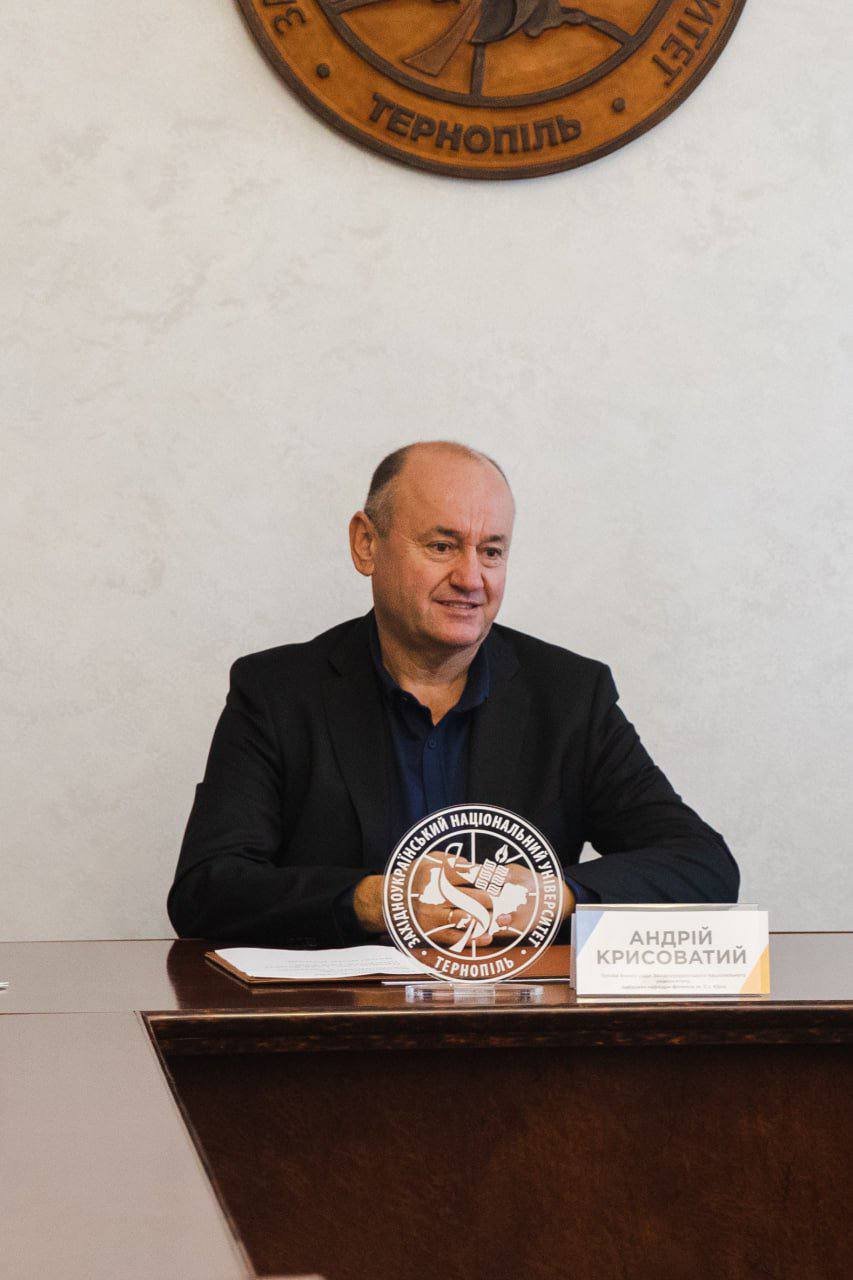
With the support of the NGO “Ukrainian-American Association of Higher Education Professionals,” as part of the “Public Finance Studies” project, a lecture and discussion was held by Andriy Krysovaty, Doctor of Economics, Professor, and Academician of the Academy of Economic Sciences of Ukraine, Honored Worker of Science and Technology of Ukraine, on the topic “Quantum Logic in Modern Public Finance.”
The lecture sparked genuine and exceptionally enthusiastic interest among the audience, as modern financial science is increasingly confronted with a paradox: classical deterministic models are no longer capable of adequately explaining the nonlinearity, multidimensionality, and uncertainty of government decisions. It is in this context that the professor drew attention to quantum logic as a modern cognitive-analytical paradigm that allows us to understand public finance through the prism of stochastic, interconnected, and context-dependent processes. Financial behavior is no longer the result of a single decision—it is shaped by the interference of probabilities, expectations, and trust in conditions of constant uncertainty.
Andriy Ihorovych emphasized that real-world financial decisions often reveal irrational paradoxes, cognitive biases, and conflicting priorities that cannot be explained using the tools of classical economics. It is no coincidence that, following the professor’s example, the key objective of the 2026 Davos Forum has been defined as dialogue—a process through which world leaders can unite and advance innovations capable of shaping the future.
Andriy Krysovaty emphasized that the fundamental principles of quantum logic in public finance are the state of financial choice, contextuality, uncertainty, and complexity.
Quantum principles are not a metaphor, but a new methodology for addressing financial issues, within which the budget, taxes, and debt are viewed as dynamic wave processes rather than mere statistical tables. The quantum paradigm allows us to view public finance as an information-energy system, where government decisions influence the collective consciousness of taxpayers and vice versa. According to the professor, the future of public finance lies in the combination of ethics, artificial intelligence, and quantum analytics.
More than 250 scholars from all over Ukraine took part in the lecture debate. The lecture was also interesting and informative for students pursuing their first (bachelor’s) and second (master’s) degrees in the educational programs specializing in “Finance, Banking, Insurance, and the Stock Market,” as well as for students pursuing a second (master’s) degree in the “Financial Literacy” program. The prospects for the use of quantum technologies in finance sparked a lively discussion.
The meeting concluded with an inspiring call from the speaker to not be afraid to be an innovative leader, to go beyond traditional approaches, and to boldly shape the future of financial science amid global uncertainty.
And Andriy Ihorovych’s words served as the final note: “Quantum finance is neither science fiction nor a metaphor, but a modern scientific tool for thinking and understanding in conditions of uncertainty.”
January 21, 2026